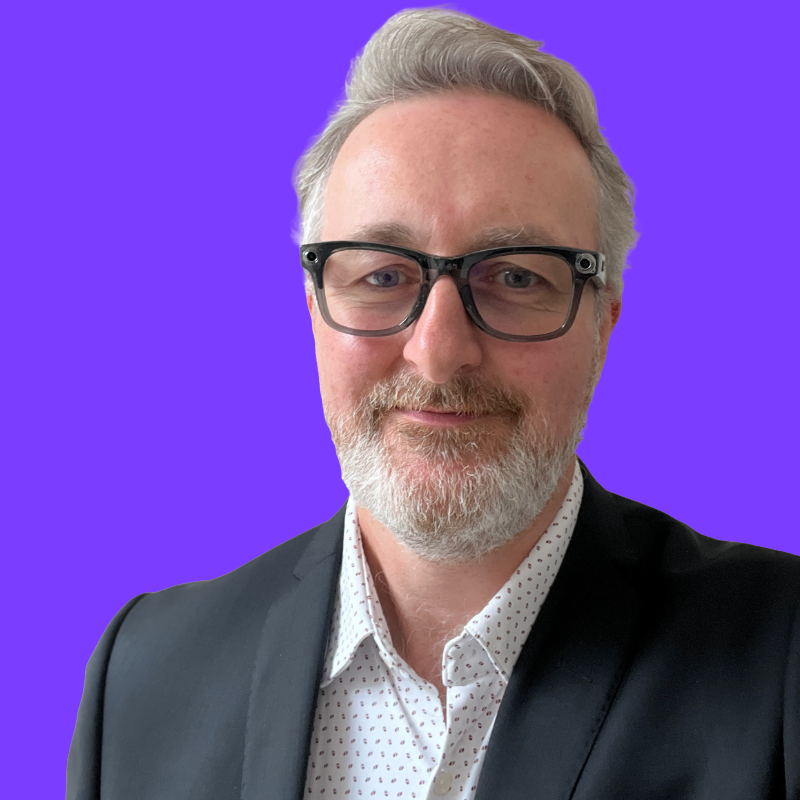
About Martin
I’ve built talent functions from the inside and advised them from the outside.
Nearly 30 years helping organisations see their people clearly and act on what they find. My mission is simple: empower leaders, evolve organisations, and make talent your strategic advantage.
My story
A senior partner told me I wasn’t cut out for law. He was right.
-
1997
Not cut out for law
I studied law. On my placement at a law firm I spent more time on the computers than on the cases, and helped rebuild the firm’s client tracking system and process. The senior partner extended my placement because of it. He also declined to sponsor my Articles, because he could see I wasn’t interested in law. He was right.
I asked him what I should do instead. “Anything in tech,” he said.
-
1997 to 2004
From tech to training
So I joined PCS, a small tech company that was soon bought by Dixons, the group behind Currys and PC World, which went on to launch Freeserve and change how Britain got online.
Three months in, I passed the Microsoft Certified Professional exam. Most people took two years, and three in four failed. The Operations Director took me aside and asked how I’d done it. I told him. He asked whether I could teach other people to do the same. I said yes, moved into training, and never looked back.
A year later he called me back into his office and asked how much it had cost him to train all those people. I said £100k, and thought he was about to fire me. Instead he told me it had generated £1m of value for the business, and asked whether I could do the same for sales, service, management and leadership. I said yes. He asked what I needed. I said a team.
By 2004 I had built a department of 15 expert trainers and training managers, and led a pan-European, award-winning learning function for 5,000 people across IT engineering, distribution, logistics and service. It taught me two lessons I still work by: learning only matters when it connects to the work, and it has to pay its way.
-
2004 to 2007
Earning a place at the table
Consulting roles at Capital One, Linklaters and Carphone Warehouse followed. I designed career pathways, succession frameworks and leadership programmes for expert-heavy organisations, where every programme had to earn its place at the commercial table.
-
2007 to 2011
Talent on the bottom line
In 2007 Apple offered me a Head of Learning role. I turned it down to pioneer a new way of identifying and developing talent across Veolia Energy UK, Dalkia and Mitie: strengths-based talent identification and development for more than 500 senior leaders. Once again, the team won an award, this time for the innovative design of a leadership training exercise.
The CEO credited that work with adding 8% to EBITDA, around £33m. It was the first time I saw a board talk about talent in the same breath as margin, and it has shaped how I have worked ever since.
I was then asked to join the executive leadership development programme, with rotations onto the Rolls-Royce, Severn Trent, Diageo and Lloyds Banking Group contracts to build my commercial and business leadership skills and fast-track me into an executive role. Running client contracts, with the margin on my desk, changed how I talk to executives about people.
-
2011 to 2018
Going independent
Following a restructure in 2011, I took redundancy, because I saw an opportunity. After years of bringing in consultants who told me what I already knew, then left before anything was implemented, I could see the gap. They often understood strategy in depth, but not how it lands inside a working organisation, and they missed the subtleties that make a project stick.
That gap was my niche. I founded SLS Ltd to work in it, adding value to more organisations than I could as one employee, through long-term relationships with clients rather than fire and forget. Clients included Selfridges and mid-sized European businesses, and the work covered talent strategy, succession, talent mapping and leadership development.
-
2015 to 2025
Building from the ground up
A consulting brief at Gamesys in 2015 turned into nearly ten years. I built the learning and talent function from scratch, became Head of Learning and Leadership Development, and after Bally’s acquired the business led the Talent Centre of Excellence as Executive Director.
Academies, succession pipelines, talent analytics, performance frameworks and DEI networks, across offices in 30 countries and 15 main locations. Once again, the team was award-winning, including the LTG Best Systems Implementation award in 2023.
-
2025
An expected ending
Redundancy came in November 2025. I had seen it coming, and I welcomed it. After the acquisition the business changed. Engagement fell from the upper quartile to the lower quartile, leadership was unwilling to address it, and investment in anything that added value beyond the essentials was cut. The innovative, talent-focused culture we had built gave way to high turnover and little appetite to invest in people. I want to spend my time with organisations that value the potential in their people.
-
Today
Inside and outside
I now run MLK Consulting, working with a small number of organisations at a time on succession, talent intelligence and leadership. I also built totalia, an app that does the analysis I used to do by hand, so a talent team can see who they have, who they need and where the risk sits, without waiting for me.
-
Next
Where talent is going
Competition for talent is about to get harder. Businesses are keeping fewer experts in senior positions, and they are all competing for the same small group of people. The organisations that come through will be the ones investing in their pipeline now, growing the leaders they will need instead of hoping to hire them later.
AI will take on more of the routine work, and that changes what talent teams do and how they are organised. Teams will need to be more fluid, moving people to where the work is. That only works when every process is written down in clear SOPs and playbooks that people and AI agents can both follow.
I have been building concepts for that talent team of 2030: a capability review of the skills the team will need in two years, a talent team playbook, academies that grow leaders for the roles that are coming, a programme board that shows who has the capacity to deliver, and augmented teams where people and AI agents work as one. The 2030 talent team starts in 2027.
What I believe
People are the strategy, not the support function.
Through the highlights and the harder moments, that conviction has shaped my practice more than anything else. When organisations treat talent as a commercial priority and invest in the conditions where people thrive, the results follow.
Follow the thinking in the newsletterAway from work
I live in Hertfordshire with my two children and our dog, Daphne. Most days start or end with a walk in the countryside with her. The rest of my free time goes on cycling, keeping fit and gaming.
Where I go deep
The full talent lifecycle, with most depth in four areas.
Each one is measured the way your board measures everything else: in cost, risk and return.
Succession & talent risk
The top 100 roles and beyond: ready-now cover, C-suite contingency and talent review cycles, so a resignation never becomes a business risk.
45% improvement in internal succession rate · 85% bench-strength coverage in 12 weeks
See how I work on thisTalent intelligence
Turning the people data you already hold into board-ready analytics, dashboards and workforce scenarios that sit alongside the financials.
£1m+ return from talent intelligence engagements
See how I work on thisTalent mapping & assessment
Calibrated talent maps, psychometric assessment and potential identification, so investment goes to the people who will repay it.
8% EBITDA uplift, CEO-attributed, from talent identification across 500 senior leaders
See how I work on thisTalent development architecture
Academies, leadership frameworks, career pathways and performance systems that lift engagement and keep your best people.
Engagement up from 78% to 92% · training completions from 1,500 to 30,000 a year
See how I work on thisHow I work
Built with your team. Still working after I’ve gone.
I work alongside your talent and HR teams, not around them. We design and build together, your people learn the method as we go, and I hand over the playbooks, tools and data so they own it.
The test of good work is what happens a year later. A solution that only runs while I am in the room has not done its job.
Credentials & awards
Awards
- LTG Best Systems Implementation, Bronze (2023)
- Award for the innovative design of a leadership training exercise, Veolia Energy UK (2007 to 2011)
- Pan-European award-winning learning team, DSGi (2004)
- Multiple internal talent and innovation awards
Qualifications
- Korn Ferry Leadership Architect (2024)
- Diploma in Transformational Coaching (2017)
- BPS Accredited Test Administrator and Korn Ferry Coach: TQ, ESCI, ILS, OCS (2017)
- Cranfield Executive Development Programme (2012)
- Lean Six Sigma Foundation, Yellow Belt (2012)
- NLP Practitioner (2003)
- LLB Law, 2:1 Honours (1997)
Who I work with
CHROs, HR Directors and senior talent leaders who need a strategic partner, not a trainer or a template.
Usually in mid-to-large, complex or regulated organisations. I have worked across iGaming, financial services, technology, energy, retail, professional services and utilities, from scale-ups to global enterprises in 30+ countries.
Clients usually come to me when
- 1 Growth, acquisition or a merger has outpaced your talent infrastructure.
- 2 Your people function is busy but disconnected from the executive agenda.
- 3 The board wants to see the commercial return on talent investment.
- 4 You need to build or rebuild a talent Centre of Excellence that lasts.
Let’s talk
If any of this sounds familiar, start with a conversation.
20 minutes, on Zoom, Teams or in person. We look at your talent situation and whether I can help.